
About Engineering Xpress
At EngineeringExpress, we understand and close the gaps between engineering education and industry practice in Nigeria. Introduce impactful curriculum and set of guidelines for developing engineering skills and competencies and effectively track and verify engineering skills for safe and innovative engineering education and practice in Nigeria.
Through this project, we are building and maintaining the capacity for safe and innovative engineering education and practice by understanding and closing the existing gaps between engineering education and practice in Nigeria.
At the end, we in partnering with NYSC to sensitize and training of corp members on the top skills for safe, innovative, entrepreneurial and sustainable development in Nigeria.
Read More
Our Mission
Our mission is to bridge the gap between engineering education and practice in Nigeria by implementing Outcome Based Education (OBE) principles. Through our EngineeringXpress programme, we aim to equip individuals with industry-relevant engineering skills, promote innovation, and cultivate an entrepreneurial spirit while ensuring safety and sustainability.
Enroll In a Course todayOur Vision
Our vision is to become a leading force in promoting sustainable engineering education, innovation, and industry-based skills development in Nigeria, fostering a culture of safety, entrepreneurship, and sustainable development.
Gallery Trends


Next Events
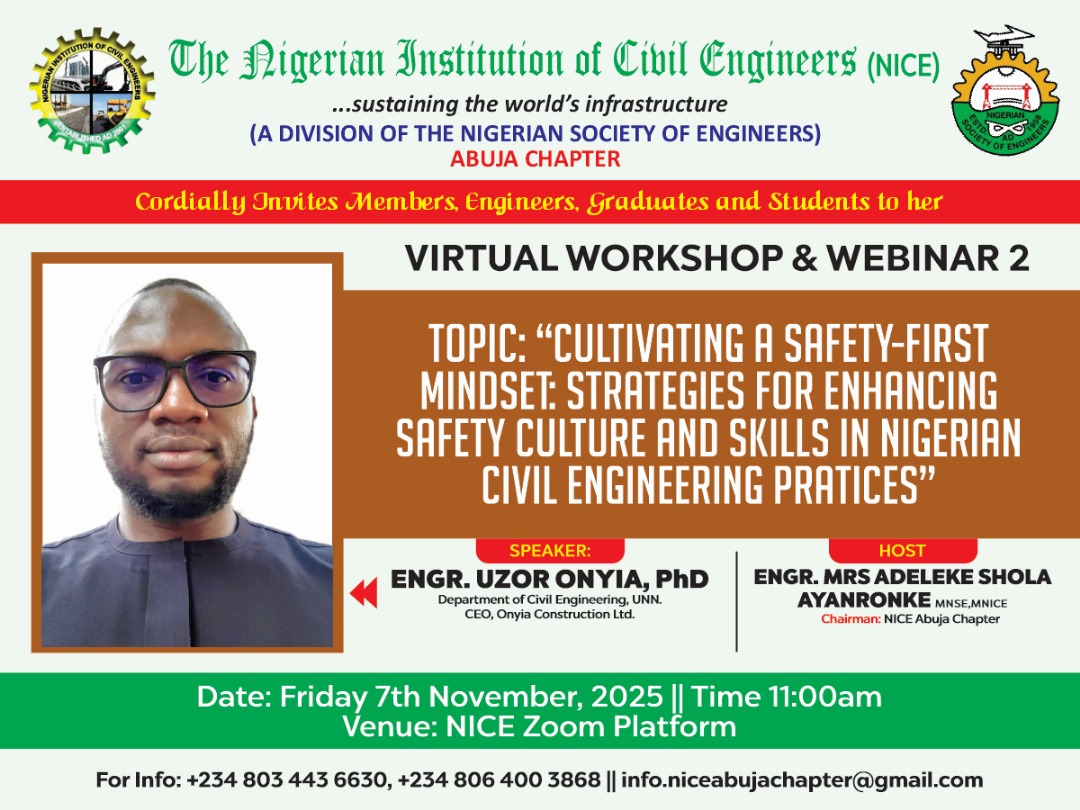
Cultivating A Safety-First Mindset Strategies for Enhancing Safety Culture and Skills in Nigerian Civil Engineering Practicies
- Nov, 07 2025|
- Online
Webinar for NICE Abuja Branch on Nigerian Safety Culture.
- A predominantly reactive safety culture—we respond to crises instead of preventing them.
- Lack of Foundational Safety Skills in key areas (e.g., Risk Assessment, Emergency Response, Supervision.
To transition from a culture of reaction to a culture of proaction and prevention.

The Safety Culture and Training Needs of Nigerian Engineers
- Dec, 03 2025|
- International Conference Center, University of Ibadan, Oyo State
This study presents a comprehensive analysis of the safety skills deficit and cultural barriers within the Nigerian engineering sector, aiming to develop evidence-based strategies for sustainable improvement to the persistent high rate of industrial accidents. Using a mixed-methods approach—combining literature review, analysis of accident reports, and a comprehensive Safety Culture and Training Needs Assessment (SCTNA) stakeholders' survey, with descriptive analysis for the quantitative data, and qualitative thematic analysis conducted on open-ended questions to establish current safety practices, root challenges, and prioritized intervention groups.
Key findings reveal a systemic crisis of commitment and capacity. Stakeholders perceive the current safety culture and awareness as merely moderate. The primary root causes of safety incidents are attributed to lack of adequate safety training and poor enforcement of safety procedures. This failure is compounded by deep-seated challenges identified through thematic analysis, dominated by economic factors like underfunding and cost-cutting, and cultural/attitude barriers like nonchalance, which serve as critical inhibitors to skill adoption. Furthermore, analysis revealed a critical failure in current training methods, as the existing safety training is only perceived as effective by a small percentage of engineering stakeholders. Consequently, the most acute safety skills needs are concentrated at the operational and entry levels with new graduates/students, due to lack of practical exposure, and site supervisors/foremen, due to their direct enforcement roles without adequate training.

Engineering Safety Culture and Skills Requirements Assessment in Nigeria
- Oct, 23 2025|
- Coronation Hall, Kano State Governmemt House
The pervasive high rate of industrial accidents underscores a critical deficiency in Nigeria's engineering sector. Utilising a mixed-methods approach which includes a review of academic publications, professional body codes, analysis of accident reports, and a stakeholder workshop with quantitative and qualitative analysis, this paper presents a Safety Culture and Skills Needs Assessment (SCSNA), investigating the current state of the engineering safety culture and identifying the corresponding skill gaps among Nigerian engineers through a stakeholders' workshop involving 99 participants representing students, academics, industry experts, advocates, regulators of the Nigerian engineering industry. Through a structured workshop and subsequent quantitative analysis, this study assesses the current state of safety culture and identifies critical safety skills needed in the Nigerian engineering landscape. Results highlight key areas for improvement in safety practices, underscore essential skills gaps among engineering professionals, and provide insights into aligning engineering education and training with industry demands. This paper contributes to understanding the interplay between safety culture and skills development in Nigeria's engineering sector, offering recommendations for enhancing safety and bridging skills gaps. The study posits that the safety challenges stem from a combination of weak regulatory enforcement, a reactive safety culture, and insufficient integration of modern safety engineering principles into practice and education. The most critical skills gaps identified are two-fold: a lack of proficiency in practical, on-site competencies such as Emergency Response and PPE Usage, and a systemic weakness in foundational practices like Hazard Identification, Training, and Supervision. This further highlights critical needs in Human Factor Engineering (HFE), Risk-Based Inspection (RBI), and Advanced Process Safety Management (PSM). The paper concludes by recommending targeted curriculum reforms, mandatory Continuous Professional Development (CPD) programs, and stronger collaboration between regulatory bodies like COREN, and industry to cultivate a resilient, proactive safety culture.
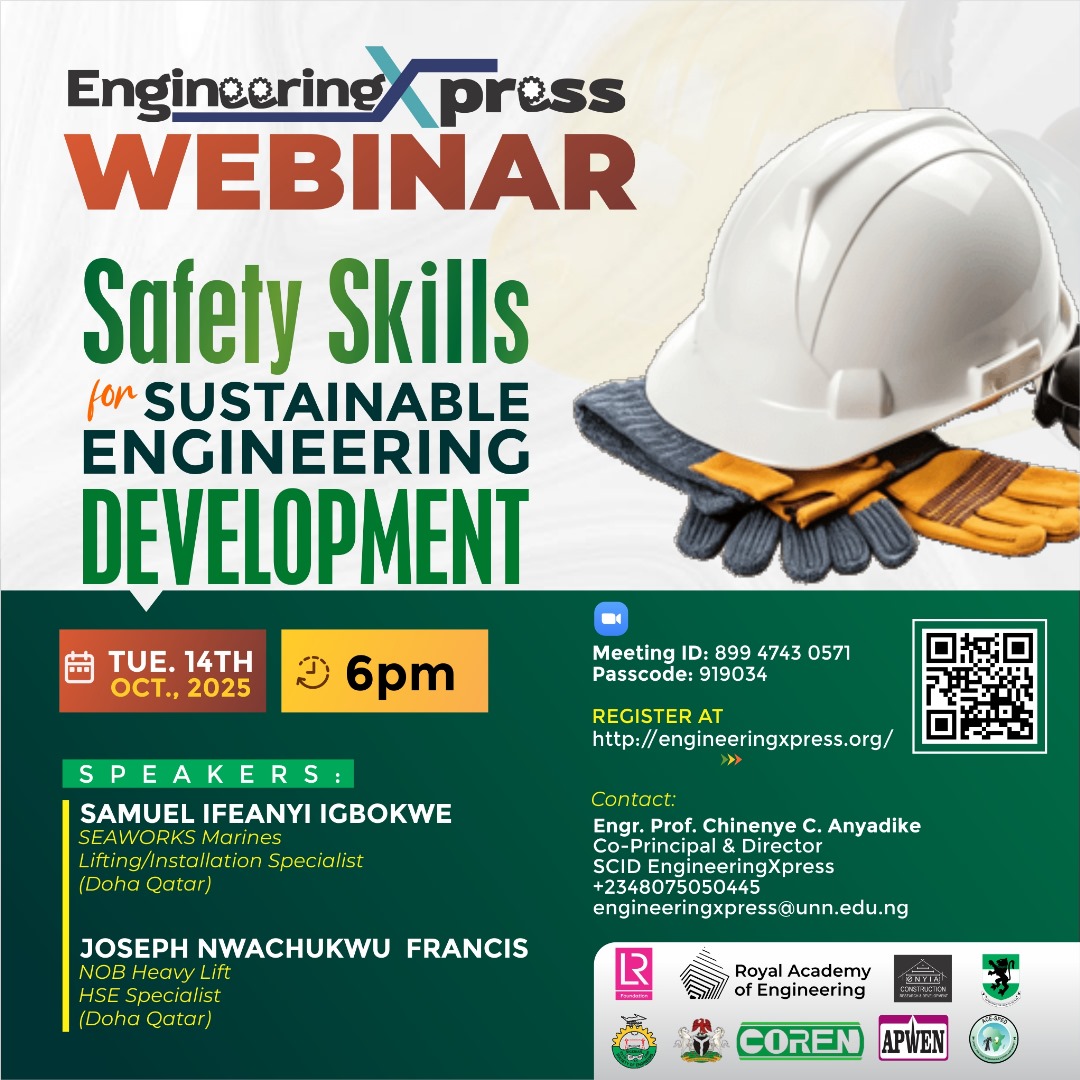
Safety Skills for Sustainable Engineering Development
- Oct, 14 2025|
- Online
Webinar Overview
The "Safety Skills for Sustainable Engineering Development" webinar was successfully hosted by the EngineeringXpress team. The event garnered significant institutional support, including backing from the Lloyd’s Register Foundation, the Royal Academy of Engineering, COREN (Council for the Regulation of Engineering in Nigeria), the Nigerian Society of Engineers (NSE), APWEN, ACESPED, UNN Consult, and various other organizations.
The session featured two distinguished speakers, Samuel Ifeanyi Francis and Francis Joseph, both of whom are seasoned engineers with over 15 years of industry experience, lending substantial authority to the proceedings.
Core Principles and Key Takeaways
The speakers established that safety is fundamentally crucial to all project development and must be integrated from the earliest stages—the design phase—through to the final implementation. Health, Safety, and Environment (HSE) procedures are not generic templates; they must be meticulously developed based on the specific project scope and comprehensive risk assessments to prevent incidents and guarantee a secure working environment.
A crucial takeaway was the intrinsic link between Sustainability and Safety. Safety officers play a vital role in promoting sustainable practices by proactively identifying and mitigating hazards. Essential skills required for this role include: hazard recognition, emergency response, and the proper selection and use of Personal Protective Equipment (PPE).
Safety Skills and Best Practices
The webinar provided practical insights into elevating safety standards through key competencies:
Challenges, Enforcement, and Opportunity
The session acknowledged the reality of implementation. A significant challenge in Nigeria is the difficulty safety officers face in enforcing compliance and implementing safety regulations effectively.
However, this challenge also presents a clear opportunity. The speakers stressed that with the adoption of the right policies and procedures—those focusing on proactive HIRA and psycho-behavioural leadership—safety officers can make a decisive and significant impact in promoting sustainability and drastically reducing workplace accidents.
Conclusion and Call to Action
The webinar successfully highlighted the profound importance of professional safety skills for sustainable engineering development, providing valuable insights into both global best practices and local challenges. The speakers unanimously emphasized the essential need for safety professionals to cultivate a deep understanding of psychology, master hazard identification, and refine emergency response planning.
The event concluded with a clear call to action: all engineers and safety professionals must prioritize both safety and sustainability as inseparable objectives in their daily work.
Apply as a tutor!


